This gritty and relentless dystopian novel from Tremblay (Off My Feet) posits a near-future world with an economy built on art.
Isobel “Izzy” Ker is a Purist artist, working in an archaic, bland style that makes her an enemy of the New Art Government and the Triggers, celebrated artistic leaders whose “gore-porn” creations are incredibly addictive, and who have cultlike followings of cruel lackeys called Hounds. Living in the resource-poor Dumps outside the protective dome of rich Mahl City, Isobel struggles to survive and keep painting. When Hounds raid her hideout, she’s forced to join the Half-Lights, a crew of anti-art rebels and thieves determined to bring down the government. The Half-Lights send Isobel into Mahl City as their spy—but Isobel’s new life posing as a Trigger proves seductive, and when her friend and fellow rebel Joanie tries to help her, the danger only increases. In an adventure that is twisty, cathartic, and extremely fast-paced, the two friends discover a new side to their world and themselves as they experience both the pleasures and horrors the art-worshipping city has to offer. The worldbuilding occasionally feels heavy-handed, especially in early chunks of exposition, but there’s no denying its originality. Replete with mind-bending thrills and chills, this proves hard to look away from. (June)
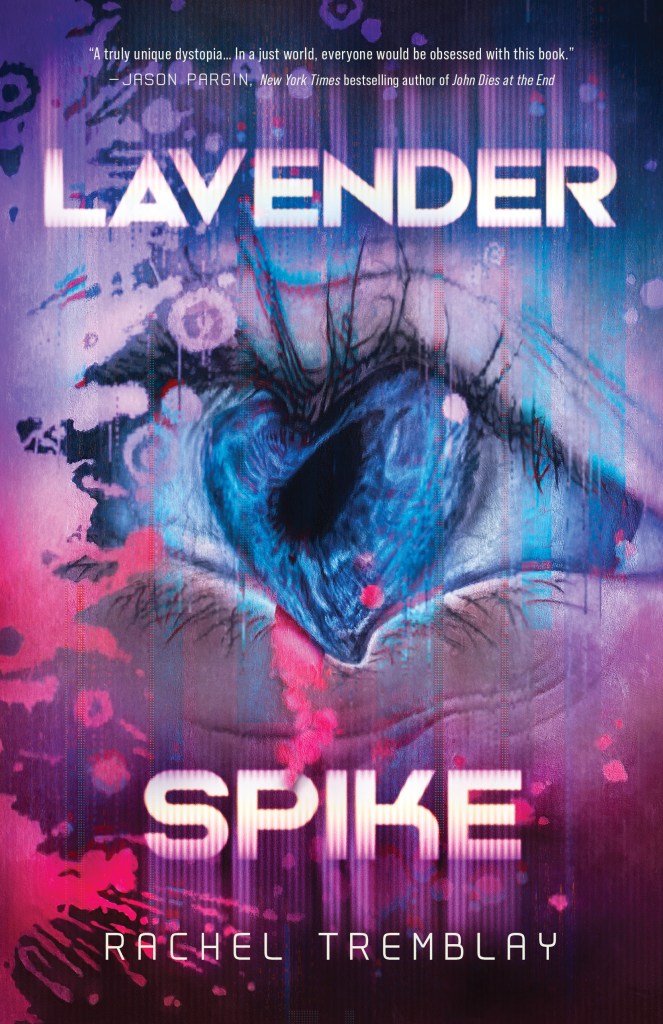
DEAR FOLX, I’m so happy to finally share the cover for my upcoming book LAVENDER SPIKE !! This is my own oil painting combined with Jess Albert’s digital touch (Jess is the Digital & Art Director at ECW Press). The universe works in strange ways and I am so happy I ended up painting the artwork for my cover! I am super stoked with the cyberlicious result.
LAVENDER SPIKE releases June 23rd 2026 with ECW Press and is now available for PREORDER from your favourite bookstores and online book-selling platforms!
“Lavender Spike is that rarest thing in fiction: a truly unique dystopia, one that shuns simple allegory and plays by its own strange and fascinating set of rules. In a just world, everyone would be obsessed with this book and fans would already be having bitter arguments about who should be cast in the film.” ― Jason Pargin, bestselling author of John Dies at the End
Isobel “Izzy” Ker, the last working artist of the Old Holy Order, lives a life of poverty in the Dumps outside of Mahl City, covertly selling her illegal paintings to the Old Order’s few remaining devotees. But when her studio is ransacked by the city’s enforcers, her only choice is to seek refuge with the Half-Light Rebels, a gang of anti-art radicals and glorified thieves.
She agrees to help the rebels, but their first mission goes south, and Izzy is arrested and brought before the leader of the oppressive New Art Government, a group that keeps people in check by feeding their addiction to a novel and dangerous craft, Trigger Art. Izzy has a choice: Convert to their way of life, using her skills to debut as a Trigger Artist, or rot in the city’s infamous prison. Izzy accepts and is thrust into the spotlight, now intoxicated by the luxury and power afforded her, not to mention her handsome bodyguard, Rilke. The wild, engrossing act of creating her first public piece almost makes her forget what life was like in the Dumps. Almost. All the while, Izzy is fanning the flames of rebellion, working in secret with the rebels and preparing to unveil her audacious debut piece.
Lavender Spike is a bold, wholly original cyberpunk novel in which art is both drug and religion.
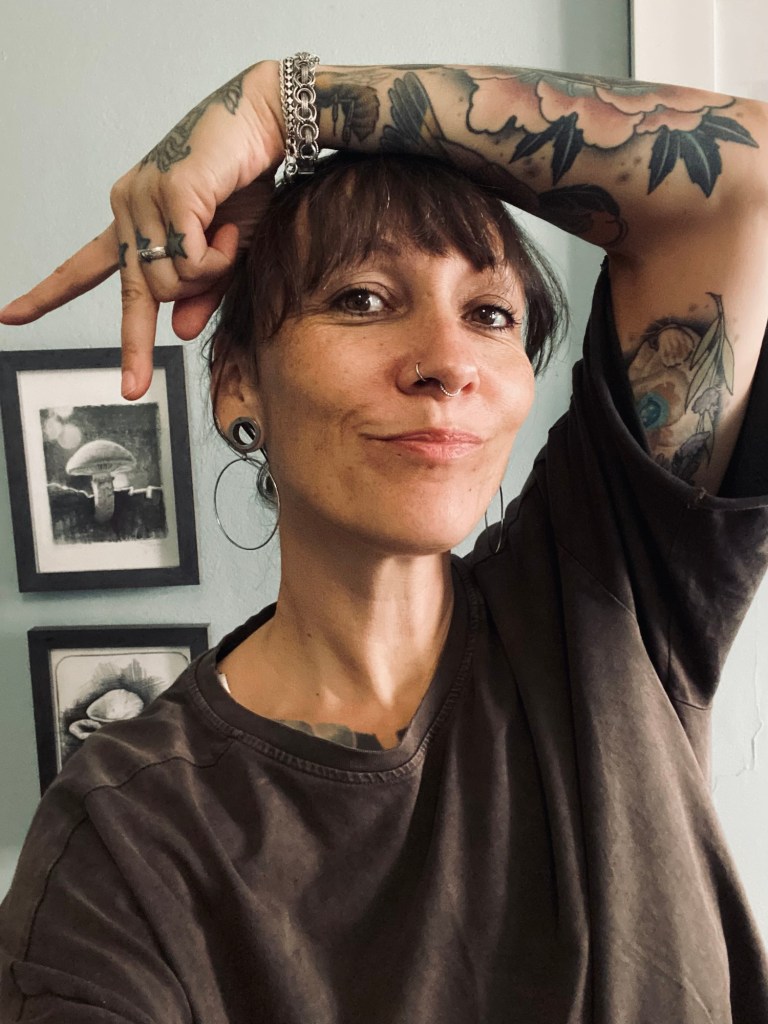
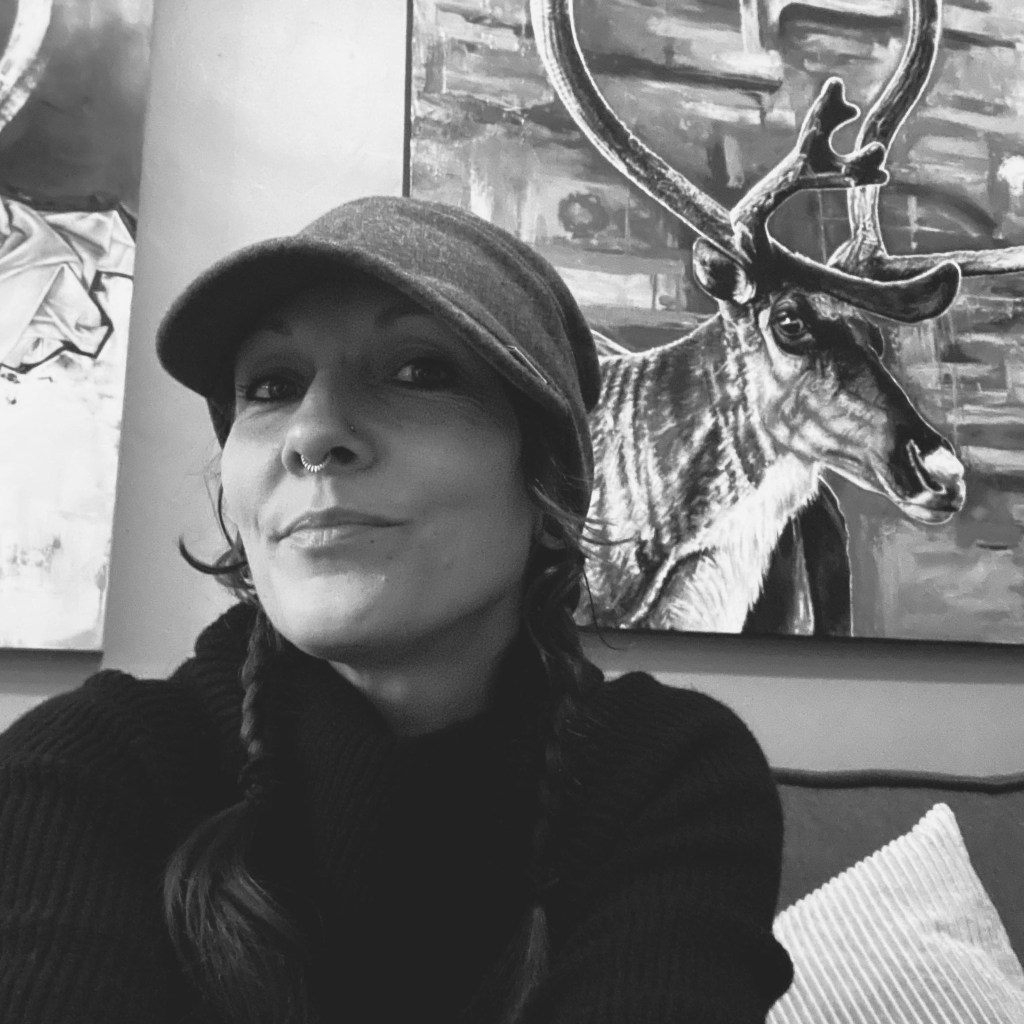
I have sent in my last edits, which I finished two days before my birthday (October 1st). Great present to myself! This photo was taken on my bday morning, feeling good, 46 and excited for every freaking day. (Can we be done with the aging taboos? A lady can tell her age, screw all that. Aging is Hot.)
So, let’s see…
I wrote Lavender Spike in 2019
Finished the first draft and wrote Dead Gretchen during Nanowrimo the same year
Published Off My Feet and Crash Kitty in 2020
Then in 2021 I started editing Lavender Spike and finished in 2022, six drafts later (my usual)
I queried on and off for 2 YEARS
In January 2024, after a heavy edit, a final polish with a hired copy editor, and getting blurbs from authors I respect immensely, I was about to self-pub it, but at the eleventh hour I sent it off to Jen at ECW Press
We signed a deal in July 2024
2025, we went through the usual cycle of edits — revision edits, copy edits, line edits, and proofread.
And I am done!!! 💥 💃 ♥️ 😍 😭
What a journey this book took me on so far. What a great experience with the team at ECW. What a good birthday gift to be done!!! I am so excited for the next steps — cover & preorders ✨
Pub day is set for April 14th 2026 💫
Thank you for taking this ride with me 🫶🏼 I appreciate you so much.
Near the end of last year, friend Lida Bergius asked to interview me for the Persian art magazine she writes for, Hafteh. As it is entirely in Persian, I am sharing it here in the original English (with permission). I have edited the length and left some questions out, for brevity and relevance. Hoping you find it interesting!
For those who read Persian, my interview can be found here , and here .
L: Rachel Trembly is an artist, musician and writer who lives in Montreal. She is a prolific painter, and has self-published four novels and is in the process of publishing two more. She has written and produced two music albums.
L:Hi Rachel, you paint, write books and compose songs/music. Can you tell us about your family background and your influences growing up.
R: I’m the result of a bahá’í upbringing by rock n’ roll musicians, a childhood of hair metal, Seattle grunge, California punk rock, east coast hip hop, horror movies, guitar shredding, skateboarding and poetry. I was always encouraged to pursue the arts and to be my strong, unique self, which led me to really click with the 90s punk subculture. The punk movement was (and is still) about empowerment and DIY (do it yourself) ethics, about freedom of thought and anti-establishment views. We believed we could live our lives in a way chosen by us, one that didn’t submit to societal standards and norms we didn’t agree with and refused to be confined by. One that was angry at the injustice in the world. These views and attitudes translated into our music, our way of dressing, and our everyday choices.
I had children young, at 23, and homeschooled them, which to me is a very punk thing to do. They were years filled with love, play, curiosity, tenderness, and freedom of movement. My kids are grown up now, artists, spiritual, fun, kind, open-minded, and my favourite people in the world.
L:What made you want to start writing stories?
R: From sixth to tenth grade I attended a tiny English school, Metis Beach School, instead of the bigger French high school in Matane, where I grew up. The beauty of a tiny school is that the teachers know each student very well. We had a lot of creative writing in our English classes there, and also a lot of arts and crafts, taught by the same teacher for both those subjects throughout most of the grades. My teacher pushed me in both areas, seeing my affinity with them. In art class she would give me extra work and ask me to help others, and in English, where I wholeheartedly embraced her guidance in descriptive writing, she encouraged me with good grades and strange statements such as “I like how you write, just not what you write about.” Because I loved to write weird, disturbing stories, even as a kid. I guess I already felt, as said by artist Cesar A. Cruz, that “art should comfort the disturbed and disturb the comfortable”. Anyway, it was there that I discovered my love for writing. I am extremely grateful to that teacher, Miss Dodson. She’s passed away now, I hope she knows how much she’s influenced my life. Even if I still love weird things!
I started writing my first novel in 2012 while doing the second workbook of Julia Cameron’s The Artist’s Way series. In this one there is a prompt to start something we have always wanted to and haven’t so far. I was eleven years old when the love of writing and the urge to embrace it as a calling surged through me, and though I wrote poetry and song lyrics regularly through my teens and young adult life, I had never taken on the task of penning a book. And so I am grateful to Julia Cameron, as well, for indirectly giving me the push I needed to go for it.
L: What is your process when writing a book?
R: I am what we call a pantser— the term comes from the saying “flying by the seat of your pants”, as opposed to being a plotter. I can have a big idea or just an inkling of one, and it is enough to start. Then I let the story unfold. I love the way Stephen King describes it, like coming across the corner of an object sticking out of the ground. We don’t know what the full thing is, but we are very curious. So we work diligently to dig it out, then to polish it, so that it can present itself fully to us. It is exciting and often surprising.
L:Can you tell us about the kind of stories you write?
R: My first novel was a high fantasy (epic fantasy set in an alternate world) called Topaz: The Truth Portal & the Color Mayhem. It is a quest-based story of a humanoid girl seeking truth and purpose and finds it through the strangest of portals: her own belly button. It’s suitable for all ages and if too young for big words (Topaz is quirky and has a flowery vocabulary), perfect to read together parent and child. Kirkus Reviews likened it to “a Roald Dahl classic”.
My other books are more geared for adults, my second one being a short magical romance called The Nirvana Threads. In this one, a young woman named Carlie loses her husband in a car accident, herself surviving thanks to a heart transplant. She moves back to her hometown, dealing with grief, PTSD, and survivor’s guilt, and there she starts seeing threads of light coming out of people’s bodies whenever they feel passionately about something. When her own threads decide to emerge, she is so in love with the intensity of the feeling that she chases it in everything, and it slowly starts to kill her. The story becomes about her need to tap into a spiritual strength not only to survive but to enjoy the beautiful, passionate things of life.
I love starting my characters in difficult places, and accompanying them through their growth. Like I heard a wonderful man, Stephen Birkland, once say (paraphrasing): “We are all worms. If we were already perfect, nothing we would do would be impressive or amazing.”
I also love to push and bend the limits of reality. There is so much room to feel in the inexplicable of a fantasy, the sense of wonder has room to breathe. Every book I’ve written so far is a little weirder and wilder than the one before it. My third one, Off My Feet, is about a woman whose lucid dreams shape – and make a mess of – her waking life, and the threat of space cats taking over the planet! It was a lot of fun to write.
L:How have you published your books and what are your plans now?
R: After spending a year trying to get a literary agent for my first book, I looked into self-publishing. The information I found was encouraging, and the creative control very alluring. I did a lot of research and preparation, got my book professionally edited, built some anticipation on Instagram amongst the bookish community, designed my cover, got my ISBN, the whole shebang. I was so converted to the idea that I didn’t even try to find an agent for my second book and self-published that one too. Then the third book came along, and I realized at this point how hard it was to tackle everything by oneself. I wanted the partnership, professional knowledge, connections, and marketing budget that comes with a traditional publishing deal. I still do! I’m currently “in the trenches”, querying my sixth book. Time will tell by what route it will be published. Meanwhile I am writing another book!
L:What are the advantages and disadvantages of self-publishing?
R: An advantage of self-pub is definitely the creative control and the speed at which you can put books out there. It is a lot longer, years often, from pen to shelf if one goes the traditional route. Another is that when the book sells, a most of the money goes into the author’s pocket instead of paying everyone along the production line. But it still can be pretty dismal without the help of publishing houses. We can’t go into this thinking we’ll get rich, self-published or not. Traditionally published authors keep day jobs too.
Speaking of money, a disadvantage is all the expenses that fall on the writer. Good professional editors are very pricey, and if you don’t create your own cover, that is also an obligatory expense, for example. Along with advertising, which can be really expensive, these things are usually covered by publishing houses. Then there’s all the work; the ever-ongoing promotion alone is a huge task. If we want to organize a book launch event, book signings, or a book tour, that is also on us. But sometimes even traditionally published authors have to organize this on their own. Especially if you’re signed with a big publishing house. They usually put their focus on their big fish.
As far as production costs, the self-published writer has access to many print-on-demand publishing platforms, like Kindle Direct Publishing, Ingram Spark, Draft2Digital, and many more. This way, we don’t have to pay up front, and we don’t have to worry about shipping. The POD service providers put the books online, printing and sending them out when purchased, taking their cut then to cover production costs.
These services have pretty much changed the game for self-publishing, making book production accessible to everyone. Even small independent publishers use them.
L:In traditional publishing, writers encounter many rejection letters. How do you deal with the disappointment of these letters and how do you keep going?
R: Rejection is hard, and after a while, plain heartbreaking. I have over 200 rejections accumulated from all my queries to literary agents and publishing houses. The reply, if we receive any at all, is usually a generic one that they send to all writers they reject, saying “thank you” and that the story doesn’t fit what they are looking for at the moment. It’s a very trendy industry—as it is with visual arts and music—and it’s hard to get through the door when we don’t fit the current mold. But not fitting the mold was always something I was proud of. To me that’s a sign I’m making art that comes from the soul.
The American modern dancer Martha Graham said: “There is a vitality, a life force, an energy, a quickening that is translated through you into action, and because there is only one of you in all of time, this expression is unique. And if you block it, it will never exist through any other medium and it will be lost. The world will not have it. It is not your business to determine how good it is nor how valuable nor how it compares with other expressions. It is your business to keep it yours clearly and directly, to keep the channel open. You do not even have to believe in yourself or your work. You have to keep yourself open and aware to the urges that motivate you. Keep the channel open. No artist is pleased. There is no satisfaction whatever at any time. There is only a queer, divine dissatisfaction, a blessed unrest that keeps us marching and makes us more alive than the others.”
Though I’ve shed countless tears over the years, and have, at least once a month, an existential crisis of greater or lesser degree, in the end I continue writing and making art because I have to. I remind myself of the beauty of uniqueness and to keep being me. I try to be as honest as I can with my work, and create for the love of it. I focus on growth and joy in and through my work. I lean on quotes like the one above. Or the one by Robert Henri: “I am interested in art as a means of living a life, not as a means of making a living.” Or the writer Kurt Vonnegut: “The arts are not a way to make a living. They are a very human way of making life more bearable. Practicing an art, no matter how well or badly, is a way to make your soul grow.”
Getting paid is nice, ideal even, and our society should honour and value the arts more. But art has to be made without money in mind, and continue to be made whether or not money comes in. That’s what makes it Art, and not a product.
L:Do you think people value reading fiction?
R: A lot do, or there would only be non-fiction sections at the book store. But I do know a lot of people who think fiction is a waste of time. Stories are powerful. They inspire change. A wonderful art form through which meaning and purpose and truth can be shared, they are a means through which we get to experience new emotions by diving into a character’s mind, seeing things through their eyes and developing our capacity for empathy. It’s impossible to read stories and not grow.
L:What role have books played in your life?
R: When I got my first library card, I was ecstatic. Not knowing where the kids’ section was, I chose a bunch of books from the adult fiction. The lady at the counter, seeing me with my big stack of thick age-inappropriate novels, laughed at me. I was so embarrassed I stormed out and only ever went back with my sister to read comic books.
In school I read some classics, of course, and a novel chosen by me here and there. My dad introduced me to The Hobbit when I was 15 and it’s still one of my favourites.
Fast-forward to when I had my first child. We read so much together, to the point that my daughter’s first sentence was “Where is the book?” Both my children were fluent and avid readers at a very young age, but still we kept reading together for a long time, because the cuddles and discussions and connections are precious and so healthy. But for myself, I thought fiction was mainly…drumroll… a waste of time. After having children, and then deciding to homeschool, I was suddenly more curious about life and the world around me than I’d ever been, and began educating myself—for myself, and for them. I read voraciously, always with an average of five books on the go, subjects spanning from the psychology of learning, nutrition, the environment, all sorts of healing arts, gardening, spirituality, and even quantum physics. I began a parenting blog. It fit my lifestyle. But when I started writing my first novel, I fell on a quote by Stephen King that said “if you don’t have time to read (fiction), you don’t have time to write (fiction).” I was upset at first, I was already so busy with children, cooking, errands, appointments, cleaning, community service, and every other thing in between which comes with homeschooling high-level performing athletes (my children are dancers). And that’s not even considering my work in visual arts and music. But still I made the time to read more fiction. Before bed is a good time, though that can result in very late nights if the book is too engaging!
I read an average of 30 to 60 books per year, which always includes a handful of non fiction. Both as a writer and a human, I’ve learned tons. Making sure to read authors from diverse backgrounds is really important. Because most books on the market are written by straight white males, if we don’t make the effort to opt for diversity, the books at easy reach will make that our perspectives remain limited.
L: You homeschooled your children. How did you manage to do that and produce your art too?
R: When the kids were small, I would go to my painting mentor’s twice a week. Sometimes there is no way to find time for work except by leaving the family behind for a few hours! I also painted or worked on music when the children went to bed. There was a time when after supper, around 9 pm, I’d make fresh coffees and urge my husband to come work on music in the basement with me. It was a shared project, and we were both tired, but one of us had to motivate the other—it’s too easy to not work on side-passions if both succumb to the couch. Anyway, that’s how we produced our second album—with caffeine-boosted crumbs of energy we scavenged at the end of the day.
L:When did you start playing music?
R: I remember learning my guitar chords at seven years old, though apparently I was younger than that. I would tinker on any instrument that laid around. Since my parents were (and are) also musicians, there were always a lot of guitars and instruments around the house and in the basement. As a child I had a little organ on which I would make up tunes or play by ear any music I had heard, and I took violin lessons for a handful of years as a pre-teen, during which I also sang in a choir. As a teen we had a drum set, which was a lot of fun for the family but also for me and my friends. My parents had signed my sister and I up for a few drum lessons to have a foundation to build on.
L: You were in several bands. Can you tell us about them?
R: As a teen I had a band that didn’t amount to much more than basement jamming, and another my early twenties, before marriage and children. That band broke up without us ever bringing our music to the stage. I had given a lot of heart to that project, so when it fell apart, I took my sadness in both hands, turned around, and started my own project. I wrote the whole of my first album on my own, recorded it at my dad’s studio with him, and pressed CD’s with the help of a funding program called Jeunes Volontaires. Meanwhile I met Mitch, my husband. He jumped in on the bass. Then my sister got on rhythm guitar and her boyfriend on the drums for our live shows. For the second album, with two children in tow, my husband and I narrowed it down to just him and I. We wrote it together, and after gigging that a bit, slowed down. Life pulled our energies elsewhere.
L:Where did you play your music?
R: We played empty bars and tiny parties, along with jam packed venues and a few small festival-type events, mostly around Ottawa and Montreal.
L: How many albums have you produced and how would you describe the music?
R: The first album can be categorized as punk rock, and the second as folk electro rock. But I’m very bad at labeling our genre. We just write what comes. Many years ago now, we met with a big shot music exec. He had listened to our second CD and told us: “This is nothing like I’ve ever heard before.” Of course Mitch and I looked at each other, thrilled. Noticing our joy, the man continued: “That’s not necessarily a good thing. I don’t know how to sell it.” And here once again we fall into being a square peg in a round hole!
L: You are a prolific painter. How would you describe your style?
R: I drew all through high school, weird fantastical illustrations. Then for a short while I explored graffiti and spray paint, but mostly drew “pieces” in my sketchbook. When I met my mentor, I learned how to draw and paint classically. Now I tend to say I’m a hyper-realist / contemporary realist.
I am always on a quest of what to paint next. But I love anything well done, as it’s the work and the heart put into that work that I admire the most. I prefer room to interpret a poetic veil, so to speak—as opposed to being explicit with a message, in both what I create and what I appreciate in other artists’ work. So to me, the subject I choose is not that important. What matters is the intention in the approach and the devotion to it. But of course I love opting for subjects that stimulate me, bring me joy, and mean something to me personally, blending my influences of classical art, fantasy illustration, graffiti writing and tattoos. Then it is up to the viewer to interpret it, and hopefully feel something good.
L: Can you tell us how you found your mentor in painting? And the importance of mentors?
R: I met Alejandro Boim after randomly entering a small gallery (now closed) beside the Marché Maisonneuve, with Mitch and my daughter in her stroller. I was floored, completely in love with this man’s work. The curator told me I should come back and meet the artist on the weekend.
Normally seeing the work would have been enough for me, but I remembered my (mostly useless) time in university where I met the Italian Montreal painter Guido Molinari. Even though his work wasn’t my style, he was the most interesting person to listen to. What might this Boim artist have to say? So I went.
I joked about taking lessons with him, having dreamed of a mentor since meeting Molinari. He told me he did give lessons, but it was too expensive for me. Still, he invited me to show him my work, asked me what I wanted to accomplish. Then he put me on the task of drawing my husband’s portrait. Even though at that time my work was mostly illustrations, I produced the drawing that night and handed it to him the next day. He then invited me to his upcoming class, and told me to not worry about the money. At the end of class, he invited me to the next one, and again told me not to worry about the money. And finally after that one, he said: “Just keep coming to the classes, and I never want to hear about money again.” I studied under his wing for about 7 years.
It was a gift, and my true schooling. Him and his spouse would do that back then—take on a few people who showed promise but didn’t have the means. Since then I’ve given free lessons too, and when life permits, would love to mentor more. Especially youth.
L: Where have you exhibited your paintings?
R: I’ve taken part in group exhibitions in galleries in Montreal, and before that I showed in coffee shops, pubs, and restaurants. I also had paintings featured in the Quebec television shows Ruptures, Unité 9, and L’Heure Bleue. I was represented for a while in a gallery in Magog, Qc, but I wasn’t happy there. Right now I have a few pieces up in a framing shop in Westmount, and the rest of my available pieces are at home with me in Montreal. I have an exhibition coming up in a tattoo shop in Montreal – Glamort Tattoo, vernissage is Sunday the 21st of January, 3 to 6 pm.
L: Where can we find your paintings and your books?
R: Right now my books are available on amazon and other online stores, and my paintings are presently split between L’Original galleries (most at 384 rue St-Paul West in Old Montreal), at Glamor Tattoo studio for a month as of January 21st, and at my home studio in Montreal. But you can find the images of my artworks and the description of my books on my website at http://www.rachel-tremblay.com
L: Is there anything else you would like to share with our readers?
R: I am grateful there is enough art in the world, in all its forms, to please all tastes, and enough tastes that people can also enjoy mine. Thank you for inviting me to share.

 rachel(le) tremblay